
A 6-week anatomical study of the space between what is seen and felt
○
A 6-week anatomical study of the space between what is seen and felt ○
VOL II
FALL 2026
Reclaim radical presence, trust the wisdom of your body, & lead your life from your own inner intelligence.
Because understanding your deeper architecture is what creates agency amidst systems that want us numb.
Learn to read the language of your body as a living map of memory and adaptation.
Your body is a living archive that’s been shaped by memory, environment, stressors and protective strategies. Every experience you have leaves an imprint on your nervous system, and informs how you move, feel, perceive, and think.
Stop outsourcing your body’s wisdom and lead your life form inner coherence.
Fieldwork explores the body not as something to fix, but as a living map of understanding and possibility. This is an invitation to question inherited patterns, reorganize the ways you've learned to adapt, and cultivate a new relationship with your body as a source of intelligence.
In Their Words
-
“Fieldwork gave me the ability to recognize how my internal state was showing up physically. I now understand my body’s signals with more clarity and can respond with care instead of pushing through.”

-
“I learned to identify when and how my mental state was impacting me physically, and developed the tools to support myself before becoming overwhelmed.”
-
“Fieldwork shifted me from constantly pouring my energy outward to recognizing my own needs, honoring my boundaries, and creating space to care for myself.”
For those who are ready to stop outsourcing the wisdom of the body,
but haven’t yet learned how to live from there…
∞
You're often thinking, planning, and anticipating what's next, which makes it difficult to fully inhabit the present moment and listen to the signals of your body.
∞
You're curious about the relationship between fascia, posture and movement patterns and want to understand how they shape how you live in your body today.
∞
You're curious about anatomy and the workings of the human body, and want to bridge intellectual understanding with direct body literacy.
∞
You dream big and constantly reimagine what's possible, so shifting from doing to being has feels just out of reach. You sense there's another way of moving through life.
∞
You’re deeply self aware yet still find yourself returning to familiar patterns of movement and thought. You want to understand how patterns are held in your body and mind.
∞
You're always in motion which makes it difficult to get out of your head and into your body, yet you feel there's wisdom beneath the patterns you've outgrown.
∞
You feel waves of inspiration yet you’re exhausted by the noise of the external world. You want lead your life from inner coherence rather than influence.
∞
You notice recurring patterns in your body and behavior and want to understand the deeper architecture beneath them rather than manage the symptoms.
∞
You who value depth and are interested in understanding the complexities of humanity through the lens of the body.
In Their Words
-
"Fieldwork helped me become aware of my patterns instead of automatically reacting to them. I left feeling more connected to myself, more present in my daily life, and with a deeper sense of self-trust."
-
"This program shifted how I relate to myself. Instead of trying to fix what I thought was wrong, I learned to become curious about my patterns, slow down, and create space for a different response."
-
"Fieldwork wasn't about fixing myself. It helped me understand myself more deeply. I now move through life with greater awareness, more compassion for where I am, and a stronger relationship with myself."
Fieldwork is a 6-week education and embodiment container designed to help you understand the deeper architecture beneath your patterns through the intersection of
○ fascia and movement science
○ nervous system patterning
○ somatic intelligence
○ embodied anatomy
This is not about “fixing” yourself.
It’s about learning how to read the body differently.
Through somatic practice, embodied anatomy, and nervous system education, you’ll learn to recognize the patterns shaping your mind and body, refine inner awareness, and reorganize your internal landscape from the inside out.
You’ll understand how stress organizes the body, how compensation patterns form, and how awareness and repetition create new pathways.
Fieldwork bridges the gap between intellectual understanding and sustainable, embodied change.
In Their Words
-
“The combination of knowledge, intuition, and embodiment created a completely different way of understanding my body. Anatomy became something I could feel, not just something I could study.”
-
“What I appreciate most is that I don’t just leave feeling different — I leave understanding myself differently. I have a clearer awareness of my body and the patterns I carry.”
-
“The work helped me develop a deeper relationship with my body. I walked away with more awareness, more curiosity, and a better understanding of how to care for myself.”
The Four Pillars of Fieldwork

01
Body Literacy
Body literacy is the practice of understanding the body's internal language, and the ground of all change. Rooted in interoception—the ability to perceive and interpret internal signals—we recognize that awareness is not a passive observation, but a cultivated form of perception through which the body reveals how it is organizing itself in response to experience.
Breath, sensation, posture, and movement is approached as meaningful forms of communication rather than isolated events. Together, they offer insight into the adaptive patterns that shape how you move, perceive, and relate to yourself and the world around you.
Body literacy reframes the body from something to be corrected into something to be understood. As perception becomes more refined, unconscious patterns become more visible, creating the conditions for greater clarity, discernment, and choice.
02
Structural Intelligence
Structural intelligence is the study of the body's architecture as a dynamic, adaptive system. Rooted in anatomy, biomechanics, fascia, and movement science, it recognizes that the body is continuously reorganizing itself in response to load, repetition, environment, and lived experience.
Rather than viewing muscles, joints, and fascia as isolated parts, we consider how they function as an integrated whole. Patterns of tension, compensation, and ease are not random—they are intelligent adaptations that reflect the body's ongoing relationship with gravity, perception, and experience.
Drawing from both Eastern and Western anatomical frameworks, we explore how structure influences function, how local adaptations shape global organization, and how the body's architecture reflects both its history and its capacity for change.

03
Nervous System Stewardship
Nervous system stewardship is the practice of cultivating a relationship with the systems that shape how we perceive, respond, and adapt. It recognizes the nervous system as an intelligent, protective network that organizes experience through prediction, sensation, and response.
Stress responses and habitual patterns are not problems to eliminate, but adaptive strategies shaped by history, environment, and lived experience. Through greater awareness and capacity, we create the conditions for the nervous system to soften, reorganize, and integrate new experiences.
Exploring the relationship between the nervous system, muscle tone, breath, perception, and behavior, we draw from neuroplasticity and neuromuscular re-education to understand how change occurs. Stewardship is not about controlling the nervous system—it is about learning to listen, support, and work with the intelligence already within it.
04
Awareness & Integration
Awareness and integration are the bridge between knowledge and lived experience. To study the body is also to study perception, meaning, identity, and the ways we relate to ourselves and the world around us.
Attention shapes experience. The beliefs we hold, the sensations we notice, and the practices we return to all influence the way we inhabit the body and make sense of our lives.
Rather than treating knowledge as something to accumulate, integration is the process of allowing insight to become part of how we move, respond, and relate. Awareness becomes more than observation—it becomes a way of meeting life with greater presence, discernment, and choice.
The Value of Body Literacy
Unearth the wisdom of your body so you can step into the spacious, grounded life that has always been growing beneath the surface.
The Curriculum
-
Before we begin exploring patterns, we begin by establishing a shared language, meeting the community, and orienting to the work ahead.
This opening session is designed to help you arrive—to become familiar with the Fieldwork framework, understand how the container will unfold, and begin observing your own inner landscape.
You will:
Move through a guided visualization to explore your internal landscape
Begin a body mapping practice to identify areas of tension, ease, awareness, and curiosity
Establish a personal baseline from which to observe change throughout the program
-
Fascia, Patterning & the Architecture of Adaptation
We begin by dropping beneath the surface of conscious behavior and into the architecture of adaptation. This week explores the body as a living archive—one shaped by memory, environment, stress, protection, and repetition.
Through the lens of fascia, posture, breath, and nervous system organization, you'll begin identifying where your history lives in the body. We’ll explore the feet and backline as foundational support systems, introducing maps of understanding how patterns are connected throughout your whole body.
You will:
Recognize inherited patterns as adaptations rather than identity
Understand the body as a map of lived experience
Observe how posture, tension, breath, and perception influence one another
Develop greater awareness of the fascial and nervous system patterns shaping daily experience
Begin identifying subconscious holding patterns and compensatory strategies
Establish a foundation of safety, observation, and curiosity for the work ahead
-
Patterning, Protection & the Brain–Body Loop
Our patterns are reinforced through constant communication between the nervous system, fascia, perception, and behavior. This week explores how the body learns protection—and how those protective strategies become woven into the way we move, feel, and relate to the world.
Through the lens of the pelvis, hips, psoas, and autonomic nervous system, you'll recognize how adaptation shapes both structure and experience. We’ll explore the relationship between tension and safety, and how unconscious patterns can be brought into awareness through observation rather than force.
You will:
Understand how the brain and body work together to reinforce habitual patterns
Recognize protective strategies held within posture, movement, and breath
Explore how the nervous system organizes around prediction, safety, and adaptation
Observe the relationship between vigilance, tension, and pelvic organization
Develop greater awareness of unconscious conditioning as it arises in real time
Differentiate between regulation and bracing within your own system
-
Breath, Bracing & Emotional Holding
The body contracts to protect what feels unsafe. This week explores the relationship between emotional holding, abdominal tension, diaphragmatic restriction, and the physiology of "holding it together."
Through the lens of the diaphragm, rib cage, deep front line, and breath mechanics, you'll begin understanding how protection is expressed through the center of the body. Together, we'll explore how stress influences breathing patterns, pressure systems, and the unconscious habits of bracing, gripping, and containment.
You will:
Understand the relationship between breath, safety, and protection
Recognize how stress and overwhelm organize the abdomen, rib cage, and trunk
Differentiate between structural support and chronic tension
Explore the connection between emotional holding and physical contraction
Develop greater awareness of how breath influences perception, regulation, and resilience
Cultivate new possibilities for support that do not rely on bracing or force
-
Neuroplasticity, Movement & Repatterning
The body is not fixed. It is continiously adapting, learning, and reorganizing in response to experience. This week explores neuroplasticity as a lived process—how movement, attention, sensation, and repetition shape both the nervous system and the structures it inhabits.
Through the spine, trunk, and integrated movement patterns, you'll explore how habits become embodied and how new pathways emerge. Together, we'll examine the relationship between perception, movement, and learning, creating the conditions for meaningful and lasting change.
You will:
Understand how repeated experience reshapes both neural pathways and physical patterns
Explore the relationship between perception, sensation, movement, and adaptation
Recognize compensatory strategies and disorganized movement patterns
Develop a deeper understanding of how the nervous system learns through repetition
Build awareness of the feedback loops that reinforce both limitation and growth
Cultivate new pathways through intentional attention and embodied practice
-
Fascia, Posture & the Emotional Body
The body adapts to what it experiences repeatedly. Over time, stress, emotion, habit, and environment shape the way we organize ourselves—creating patterns that feel natural simply because they are familiar.
This week explores fascia as the connective architecture of the body and posture as an expression of adaptation. Through myofascial tracking and meridian theory, you'll begin seeing how strain patterns travel through the body which influence movement, perception, and the way you inhabit yourself.
You will:
Explore the relationship between fascia, posture, and nervous system organization
Understand how repeated experiences shape structural and emotional patterns
Observe how compensation and strain travel through interconnected lines of the body
Recognize the connection between posture, perception, and emotional experience
Differentiate between rigidity and genuine support
Cultivate greater ease, efficiency, and coherence within your structure
-
Jaw, Voice, Expression & Control
The face is often the final expression of the patterns carried throughout the body. The jaw, throat, eyes, and neck reveal how we orient toward the world—how we communicate, protect, suppress, perform, and connect.
In this final week, we explore the relationship between facial tension, nervous system load, expression, and perception. Through the structures of the head, neck, jaw, and sensory systems, you'll begin recognizing how adaptation influences not only how you feel, but how you relate, communicate, and are perceived by others.
You will:
Understand how vigilance, effort, and control manifest within the face, jaw, and neck
Explore the relationship between muscular tension, expression, and communication
Recognize patterns of suppression, over-efforting, and performance within your own system
Observe how stress influences perception, orientation, and social engagement
Develop greater capacity for embodied expression and authentic communication
Integrate the patterns, insights, and observations cultivated throughout the Fieldwork journey
In Their Words
-
“Giustina has a gift for making complex anatomy digestible, helping me understand the body as an interconnected system rather than isolated parts.”
-
“I became more curious about not only anatomy, but the physiological experiences of the human body—learning to see the body as something to experience, not just understand.”
-
“Being able to visualize and feel the interior of my own body allowed the information to land in a completely different way.”
Why This Work Exists
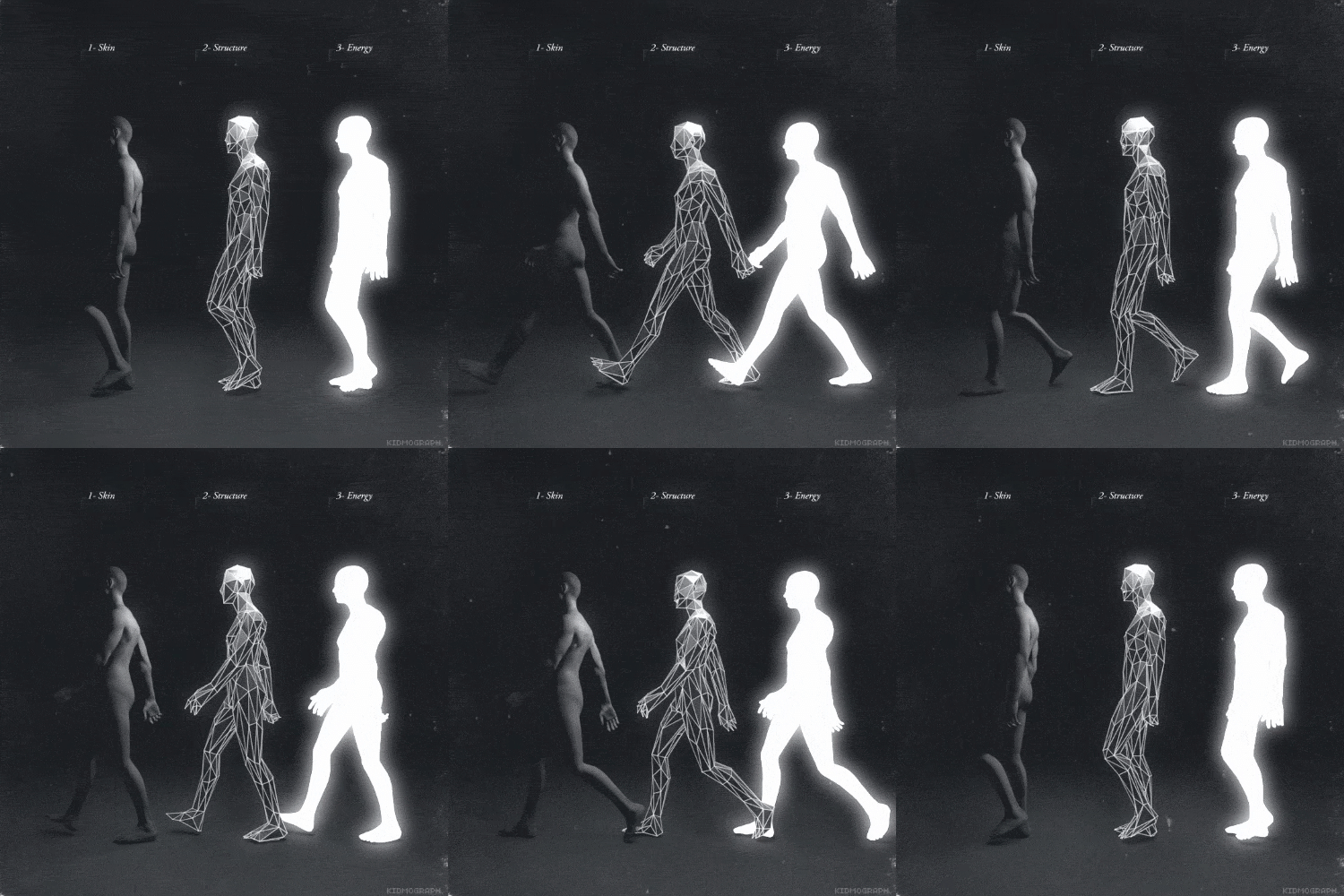
My background is formal: anatomy, education, movement science, bodywork. But what I’ve learned is this—
Wisdom doesn’t live in textbooks alone.
It lives in tissue. The breath. The posture. In the pause.
You can do all the trainings in the world and still not understand why certain patterns persist.
Because it isn't just about having the right information—it's about understanding how experience organizes the body. How stress, adaptation, compensation, and repetition become woven into posture, breath, movement, perception, and behavior.
Here, we don't just learn about the nervous system—we learn how it shapes experience.
We don't just study anatomy—we explore how it is lived.
We don't treat patterns as problems to fix—we learn to recognize the intelligence beneath them.
This is where anatomical knowledge meets the lived experience of being human.
And that's not something meant to be done in isolation. Understanding deepens when it is witnessed. Insight expands through reflection, dialogue, and shared inquiry.
In this space, you're not asked to arrive "healed," "regulated," or already knowing the answers. I invite you to arrive curious. This kind of work is intimate.
You'll trace lines of tension and adaptation. Explore the relationship between structure and experience. Study the patterns that have quietly shaped how you move through the world.
You'll bring unconscious maps into view. Notice what has become automatic. Recognize what has become familiar. Create space for something new to emerge.
From that place, you move through life from possibility instead of habit. You develop a deeper relationship with your own internal landscape and step into who you wish to become.
And over time, what once felt fixed begins to reveal itself as adaptable.
In Their Words
-
“Her ability to layer information, honor different learning styles, and connect anatomy to lived experience made a complex subject approachable and meaningful.”
-
“Giustina’s approach helped me connect anatomical concepts with real movement, creating a deeper understanding of how the body functions as a whole.”
-
“Learning anatomy with Giustina shifted it from something I could memorize into something I could actually feel and understand within my own body.”
Inside the Field
Three Months Access of Inner Field Studio
1
Inner Field Studio is my online community for ongoing embodied study and sustainable self-practice. This is where the work lands in the body through weekly livestream practices and the on-demand library of resources and practices. Your Fieldwork enrollment includes three months of full access.
(6) Prerecorded Modules & Coursework
2
Each week, you’ll receive a new prerecorded lesson exploring the anatomy, fascia, nervous system, and embodied patterns connected to that week’s theme. These lectures are designed to help you understand the deeper architecture beneath posture, tension, movement, perception, and behavior.
(6) Weekly Live BodyLab & Q+A Calls (90 Minutes)
3
A live space for integration and discussion. Bring questions from weekly modules, reflections from the coursework, or patterns you’re noticing in your own body. We’ll map what’s happening beneath the surface and explore the anatomy, nervous system, and structures shaping your experience. This is where theory becomes lived experience.
5
Private Community Space
Throughout the program, you’ll receive a collection of practices, body mapping exercises, and reflective tools woven throughout the curriculum. Each is designed to support deeper awareness, connect the teachings to your lived experience, and help integrate the work beyond the weekly lessons.
A dedicated space for reflection, conversation, and shared inquiry throughout the container. Weekly discussions continue directly within each lesson thread, allowing live calls to build from the real-time observations, questions, and experiences emerging inside the group.
Ongoing 1:1 support via the “Ask G” channel
6
A direct line for questions, reflections, and moments where you need orientation as the work unfolds. Bring your realizations, observations, patterns, and personal inquiries for continued guidance, support, and deeper understanding throughout the program and between our calls.
An alumni-only space to keep tending the work after Fieldwork. Through monthly BodyLab hot seats, anatomical explorations, and ongoing conversation, this is a place to deepen your relationship with the body and continue the study together.
Weekly writing prompts and accountability worksheets to support deeper observation, pattern recognition, and integration throughout our six weeks together.
A lived opportunity for deeper self-contact
9
Space to explore the unseen patterns shaping your body, perception, and experience—and develop a more grounded, aware, and embodied relationship with yourself from the inside out.
Weekly Practices & Body Mapping Exercises
4
Invitation to The Living Field
7
Weekly Practices
8
Fieldwork Vol 2: Fall Cohort
September — November 2026
○
Available Spots
Limited to 15
○
Program Begins
September
○
Applications Open
TBA
○
Program Concludes
November
○
Time Commitment
6 weeks live + self study
○
Weekly Live Calls
TBA based on group needs
○
Financial Investment
$1,500 $1,200 (waitlist price)
○
Payment Plan
3 x $400 or 4 x $300

The Roots of this Work
I’m Giustina. I’ve spent over a decade teaching people about their body—how to inhabit it, understand it, and relate to it from the inside out. My work has lived in many places, from retreat centers, college curriculums, yoga teacher trainings, and intimate one-on-one sessions—but at the heart of it all is something much simpler.
It’s about learning how to read ourselves more clearly.
To understand how experience shapes the body. How stress, adaptation, protection, and repetition organize into posture, breath, movement, tension, and perception. To build a relationship with the body that feels intelligent, sustainable, and grounded in awareness rather than correction.
My approach blends structural and functional anatomy, trauma-informed yoga, somatics, hands-on bodywork, nervous system education—not as abstract concepts, but as lived experience. Over 13 years of working closely with clients and students, I’ve seen how clarity and agency naturally emerge when people begin to understand the deeper patterns shaping their experience—and learn to work with the body rather than against it.
My work weaves:
• the art and science of the body
• the intelligence of sensation
• the precision of biomechanics
• the spaciousness of contemplative practice
• the subtle magic of the inner landscape
When the body becomes intelligible rather than something to override or fix, something begins to soften. We develop a deeper relationship with ourselves. Awareness expands. Choice becomes more available. The body shifts from something we manage to something we can meaningfully listen to.
I created Fieldwork because understanding ourselves requires more than information. It requires observation, embodiment, and relationship. This is a space to study the hidden architecture beneath your patterns—where anatomy, nervous system science, movement, and lived experience converge.
This is the work beneath the surface… meet you there?
If you’re ready to understand the deeper patterns shaping your body, perception, and experience—you’ll look back and see that what once felt subconscious is visible, and your body transformed from something you once tried to manage, into something you meaningfully listen to.